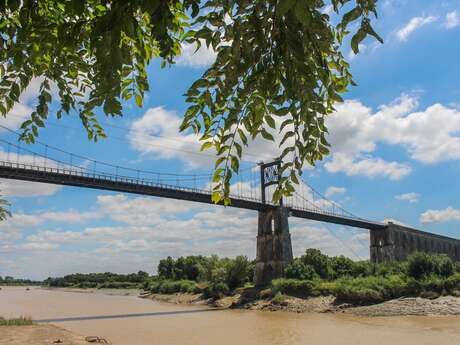
Within the boundaries of the Grand Site de France and the Natura 2000 area, discover the imposing Tonnay-Charente suspension bridge. A walk through nature and history.
Along your route, you will pass the following landmarks:
- The Cèpe Bridge: Inaugurated in February 1889, this architectural masterpiece was built to enable rail traffic between Rochefort and Pointe-du-Chapus. This branch line of the Rochefort–Saintes railway played a key role in the economic development of Marennes by facilitating trade in local products such as salt, wine, timber, fish and oysters, as well as chemical products manufactured in the town’s factory.
- The Tonnay-Charente...
Along your route, you will pass the following landmarks:
- The Cèpe Bridge: Inaugurated in February 1889, this architectural masterpiece was built to enable rail traffic between Rochefort and Pointe-du-Chapus. This branch line of the Rochefort–Saintes railway played a key role in the economic development of Marennes by facilitating trade in local products such as salt, wine, timber, fish and oysters, as well as chemical products manufactured in the town’s factory.
- The Tonnay-Charente Suspension Bridge: Engineer Lazare Dor first submitted plans for a suspension bridge as early as 1831. The structure was intended to replace the ferry crossing on the royal road linking Bordeaux and Saint-Malo. However, construction was not officially authorised until a royal decree was issued on 24 August 1838. Stretching for more than 650 yards and rising to a height of approximately 72 feet, the bridge has been listed as a historic monument since 1988.