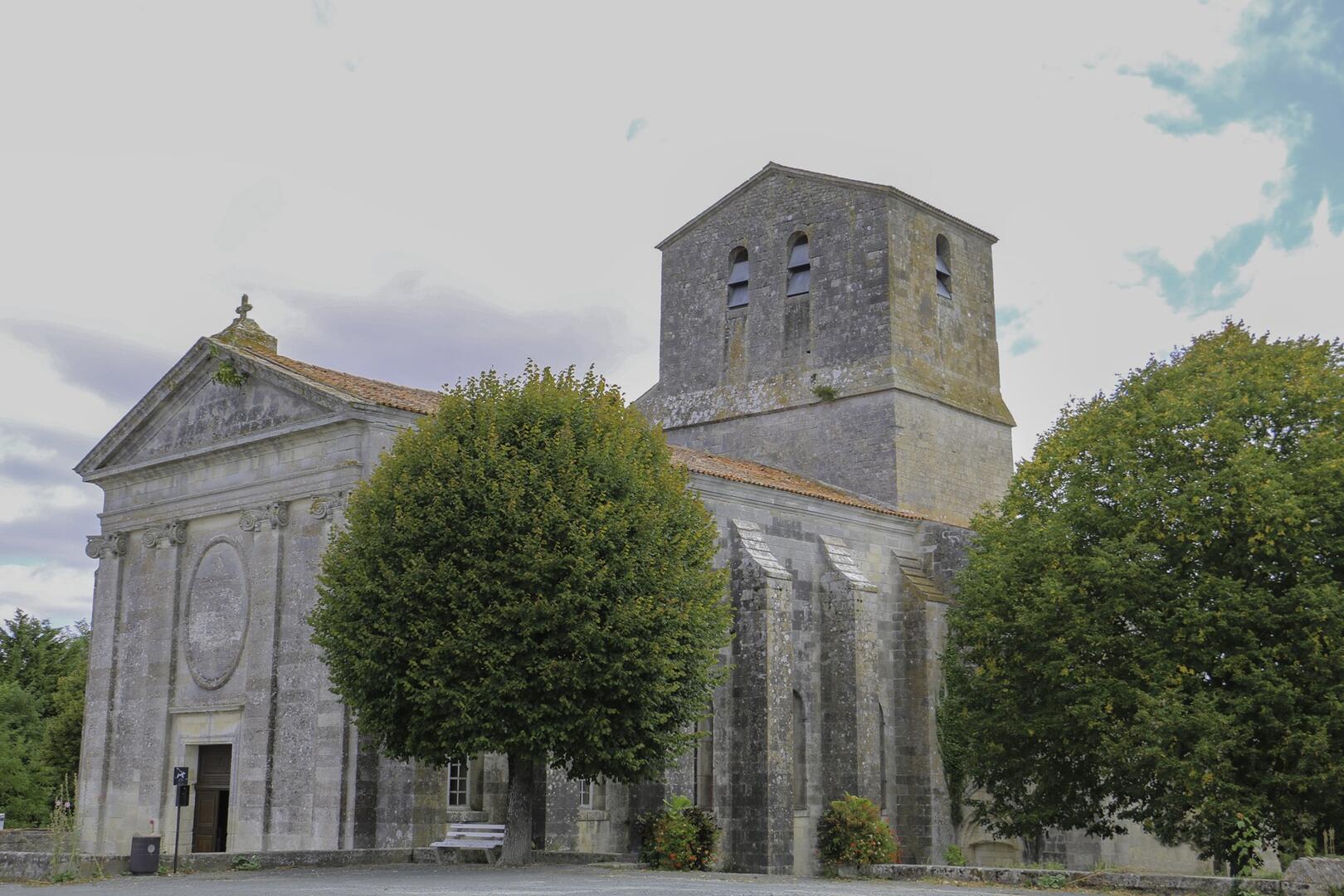
Saint-Pierre Church in Soubise
Historic site and monument
,
Religious heritage
,
Church
in Soubise
-
The history of Saint-Pierre Church in Soubise is closely linked to that of the former Principality of Soubise. Originally, it was a Romanesque collegiate church within the Diocese of Saintes, served by a prior and canons. Several phases of construction and alteration, from the 12th to the 18th century, have shaped its current architecture.
The medieval building was repaired in the 15th century, particularly the arcades at the crossing of the transept. It was subsequently largely destroyed...The history of Saint-Pierre Church in Soubise is closely linked to that of the former Principality of Soubise. Originally, it was a Romanesque collegiate church within the Diocese of Saintes, served by a prior and canons. Several phases of construction and alteration, from the 12th to the 18th century, have shaped its current architecture.
The medieval building was repaired in the 15th century, particularly the arcades at the crossing of the transept. It was subsequently largely destroyed during the Wars of Religion. In 1566 and 1567, the Catholic faith was banned on several occasions in Soubise, and the nave and choir were largely destroyed.
Between 1700 and 1712, Hercule-Mériadec de Rohan, Prince of Soubise, had the nave rebuilt at his own expense. The new façade was designed in a classical style, featuring pilasters with Ionic capitals and a triangular pediment. The nave, of vast proportions, was covered by a barrel vault.
The eastern part of the church, however, retains some particularly interesting medieval features. At the crossing of the transept, massive carved capitals support a rare Gothic vault with eight sections, known as an octopartite ribbed vault. The transept arms are covered by barrel vaults or groined vaults, whilst the choir, now truncated, retains a ribbed vault resting on small capitals decorated with foliage. A few windows and historiated capitals also bear witness to the former Romanesque construction.
The massive square bell tower rises above the crossing of the transept. It is accessed via a spiral staircase housed within a cylindrical turret. Having lost its timber-framed spire on several occasions, notably following damage caused by lightning, it was given its current roof in the mid-19th century.
The church’s history is also reflected in its décor. Around 1749, a funeral frieze was painted on the walls of the nave in tribute to Hercule-Mériadec de Rohan, who died that year. Against a black background were depicted the coats of arms of the Rohan family and of Brittany, surmounted by a ducal crown and a mantle of peerage. Damaged during the Revolution, this decoration was rediscovered in the early 20th century.
The church also houses an ex-voto created in 1748 by a certain Roussel. It depicts Saint Elmo and Saint Clare, accompanied by the Virgin and Child and the Holy Spirit. Two three-decked ships appear on the left-hand side of the composition, recalling Soubise’s historical link with the estuary and seafaring.
Listed in its entirety as a Historic Monument since 27 May 2009, Saint-Pierre Church stands as a remarkable testament to the religious and seigneurial history of Soubise, where Romanesque heritage, Gothic architecture and classical reconstruction coexist.
-
-
Environment
-
Openings
-
Openings
-
-
All year 2026
Open Everyday
-
All year 2026